
Rational choice theory in economics, contractual voluntarism in law, and utilitarian theory in philosophy assume that we are rational beings: when we make decisions, we perform more or less conscious calculations in order to maximize our utility—that is (to summarize), our well-being. This is, of course, a model and not an exact description of our behavior. However, cognitive psychology and behavioral economics tend to show that this model lacks the explanatory power to account for many of our behaviors.[1]
In reality, we are far from acting rationally at all times. Our rationality often gives way to our many cognitive biases (ways of thinking that systematically deviate from logical or rational thinking, or that produce distortions in how we process information). Our quick, intuitive ways of making judgments or decisions have one advantage: they require less time and energy than an analytical way of thinking that would take all relevant information into account.
Many authors today agree that our rationality is expressed in practice only to a limited extent. Even when we believe we are acting rationally, with caution and diligence:
We are fundamentally distracted (or alert to danger, depending on your point of view)
Our attention can be focused, but that means it is also biased (we narrow our view of reality, like a lighthouse at night that illuminates only a tiny portion of the surroundings)
Our ability to process information quickly becomes overwhelmed, especially when we have to combine mental and motor tasks (magicians and other illusionists understand this well)
Cognitive biases

[2] Chainsawsuit.com, “Confirmation Bias,” 2014, http://chainsawsuit.com/comic/2014/09/16/on-research/
Here are a few examples of cognitive biases that can lead to distortions or errors when we process information:
Confirmation bias: We tend to seek out and consider only information that confirms our beliefs, and to ignore or downplay the importance of information that contradicts them.
Belief bias: We overlook logical errors when the conclusion of an argument aligns with our beliefs.
Framing bias: We are influenced by the way a problem is presented. For example, we are more likely to accept a surgical procedure if it is presented in terms of success rates rather than failure rates, even though the numbers actually mean the same thing.
Anchoring bias: We tend to place undue weight on the first piece of information we receive about a topic.
Hasty generalization bias (also known as the “representativeness” bias): We tend to make judgments or identify patterns based on a few examples that are not necessarily representative.
These cognitive biases also affect our short- and long-term memory:
Primacy effect: We remember the first items on a list better.
Recency effect: We remember the most recent information we encounter better.
All of these cognitive biases exist for a reason. With all due respect to rational choice theory, these cognitive biases allow us to process a massive amount of information satisfactorily and very efficiently.
According to user experience design expert Buster Benson, co-author of this mind map listing more than 200 cognitive biases[3], our cognitive biases enable us to address four major problems.
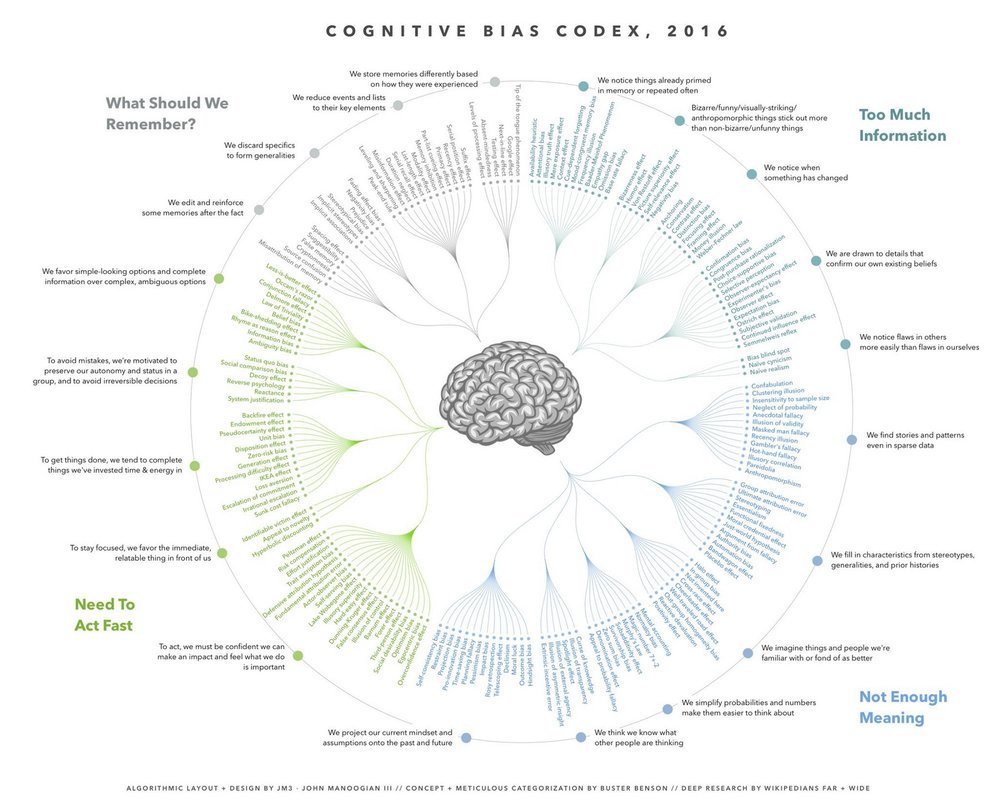
Design by JM3, John Manoogian III; Conceptualization and categorization by Buster Benson; Research: Wikipedians from around the world.
1. Too much information
Simply put: there is too much information in the universe for our brains to process it all. We have no choice but to filter out almost all of it. We are constantly breaking down reality to understand and interpret it. Our brains focus on certain aspects, while other aspects—which might actually be crucial—can slip under our radar. This doesn’t necessarily mean we act irrationally, but the amount of information we rely on to act is seriously limited by our cognitive abilities.
2. Not meaningful enough
We need to make sense of the world around us. This involves creating and using mental models to fill in the gaps in our information. These are cognitive shortcuts, also known as heuristics. For example, for a long time, Europeans believed that the Earth was flat.
But these mental models are not always sufficient or accurate, and they are difficult to change once they have taken root. As the saying goes, prejudices die hard. Galileo learned this the hard way when he tried to convince his contemporaries that the Earth is round and revolves around the Sun.
3. The need to act quickly
Without the ability to act quickly in the face of the unknown, we probably wouldn’t have lasted long as a species. We cannot let a lack of information—and a lack of time to gather more—paralyze us. When we receive new information, we must assess its significance, determine whether action is needed, simulate future scenarios to predict what might happen, and decide how to respond—sometimes in record time.
4. Knowing what we need to remember for later
Our long-term memory is a bit like a huge reservoir fed by a tiny garden hose. Theoretically, there is no limit to the amount of information we can store, but we must make sustained efforts to do so.[4]
Impact on Information Processing
1. We don't read everything
Among all the information we discard when selecting what we consider essential or important, we also overlook important and useful information—especially if that information is complex and abstract.
2. Our mental models can lead to errors or cause us to miss the point
When we’re looking for a specific piece of information, we pay attention to what confirms our perspective and downplay information that doesn’t align with our beliefs or goals. We sometimes imagine details based on our biases, we assign meaning to things that have none, and we compensate for the lack of meaning by inventing stories or patterns that don’t truly correspond to reality. “You can’t know what you don’t know that you don’t know”: our understanding of the world means we have blind spots. As a result, we may miss what’s most important.
Take the quiz! How many passes does the team in white make?
3. We can make bad decisions
When we lack information (which is most of the time), we may make decisions that are counterproductive, unfair, or even contrary to our own interests. In short, we make decisions that may seem rational at the time, but that doesn’t mean they actually are.
In fact, in certain contexts, we consistently act irrationally, largely because of our cognitive biases.[5]
4. Our memory reinforces our cognitive biases
Some of the information we retain serves to reinforce the processes of perception, cognition, and decision-making described above, which can further reinforce our existing biases.
Design Objectives for Clear and Effective Content
What should you take away from this?
We humans are fundamentally easily distracted
We are far from acting rationally all the time
Just because information is written or published doesn't mean it will be read and understood
Never assume that what is important to you is also important to your reader
Creating clear and effective content requires taking into account the way people consume information: at a rapid pace, taking shortcuts, and with a level of motivation and attention span that can sometimes be very limited.
Clear and useful content should enable the user to:
Effectively identify important information or the information they are looking for
Read Easily ( and Read the Right Content)
Easy to Understand
Remember the Essentials
Sources
[1] See, in particular, Daniel Kahneman (2002 Nobel Prize in Economics), *Thinking, Fast and Slow*, Doubleday Canada, 2013; Cass Sunstein and Richard Thaler (2017 Nobel Prize in Economics), *Nudge: Improving Decisions, Health, Wealth, and Happiness*, Penguin, 2009; Dan Ariely, *Predictably Irrational: The Hidden Forces That Shape Our Decisions*, Revised and Expanded Edition, Harper, 2011; for a nuanced critique of rational choice theory, see the work of Jon Elster.
[2] Chainsawsuit.com, “Confirmation Bias, ” 2014.
[3] Buster Benson, Cognitive Bias Cheat Sheet, Simplified – Thinking Is Hard Because of 4 Universal Conundrums, January 8, 2017.
[4] For a history of mnemonic systems—or how humans were able to memorize works as long as the *Iliad* and the *Odyssey*—see Frances A. Yates, *The Art of Memory*, Pimlico, 1966.
[5] Dan Ariely, *Predictably Irrational: The Hidden Forces That Shape Our Decisions*, Revised and Expanded Edition, Harper, 2011.
Learn More
Discover our service for simplifying your complex content.
Sign up for our training course, “The Art of Clear Communication and Information Design.”