
Several laws and regulations require clarity, simplicity, and conciseness. Consider the Plain Writing Act in the United States and the various requirements of this nature set forth in Quebec regulations.
The new General Data Protection Regulation (GDPR) of the European Union is therefore nothing revolutionary at first glance, as it requires that policies and other communications regarding the protection of personal data be concise, readily accessible, and easy to understand.
But what surprises us about this regulation, which takes effect on May 25, 2018, are the particularly high standards recommended in the Transparency Guidelines — standardslargelyinspired by the principles of clear and effective communication and information design. This is sure to delight experts in legal information design (legal designers).
Here are four recommendations from these guidelines that we found particularly appealing.
Admittedly, they are not binding, but they may influence the assessment of companies’ compliance with the regulation’s requirements. They therefore deserve our full attention!
The only downside worth noting is that the Regulation and the Guidelines do not lead by example. As proof, the preamble to the GDPR consists of 173 paragraphs, with no subheadings to break up this mass of information. Talk about the cobbler’s children having no shoes!
1. Focus on timing by displaying information about personal data at the right moment
From now on, you must not only provide information about personal data, but also “push” that information at the right time.

For example, by displaying apop-up message when the user enters their phone number.
Microsoft Corporation, Application Download Interface, 2018
What Delights Us
The regulation acknowledges that information read out of context is more difficult to understand.
The reality is simple: even after reading an entire privacy policy, users are not sufficiently equipped to detect when their personal information will be collected or to understand how an organization will use a particular piece of information. Nor can they remain constantly vigilant.
Users therefore need to be reminded of their rights and the risks they face at the appropriate time—a responsibility that now falls to organizations.
2. Periodically check to see if the information is appropriate for your readers
For a text to be accessible and easy to understand, it must be written with the reader’s needs in mind. The guidelines therefore require that you clearly define your audience and its level of understanding.
What Delights Us
Not only must you identify your target audience and the characteristics of the average reader early on, but you must also periodically verify whether the reader you have identified is, in fact, the actual reader.
Depending on the situation, you should tailor your content to that specific reader.
3. Use visuals... even comic strips
The guidelines suggest various communication tools, including infographics, flowcharts , and even comic strips!
What Delights Us
When well-designed, visuals can undoubtedly help people understand more abstract or technical concepts. Comics—which are less commonly used in official texts—are very effective at raising awareness, educating, and informing, especially when targeting audiences with low literacy levels for whom pages filled with words can be a challenge.
Images can also help people remember key information, given that the law is often abstract and therefore difficult to apply to everyday life.

Example: Standardized icons
A set of standardized icons to communicate information about personal data more effectively. (These icons have no official status.)
Privacy Tech, Privacy Icons
A few examples from other fields
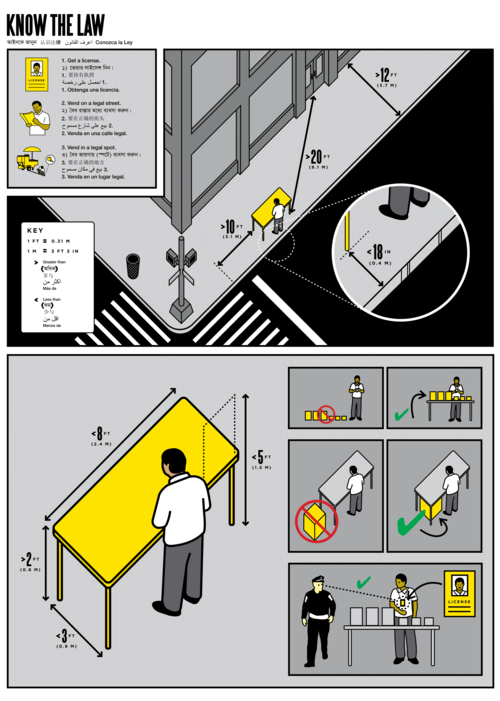
An illustrated guide for street vendors in New York City, translated into the five languages most commonly spoken by these vendors.
Center for Urban Pedagogy, *Vendor Power!*, Brooklyn, 2009

Stand out from the crowd
A contract presented in comic book format, designed for people with low literacy levels and multicultural audiences. Visit creative-contracts.com
Robert de Rooy, Employment Contract, Cape Town, South Africa - www.creative-contracts.com
It’s worth noting, however, that comics aren’t always appropriate. Consider a user who is in a hurry to buy a product. A comic could create visual clutter and slow down the purchasing process.
Surprisingly, the guidelines mention infographics, flowcharts, and comics in the context of an organization providing information in print, even though, in our opinion, these tools are just as relevant for the web.
4. Explain what significant or unforeseeable consequences may arise for users who provide their personal data
Gone are the days when some organizations tried to hide part of the truth by being vague, imprecise, or ambiguous! The guidelines require complete transparency.
What Delights Us
You must clearly explain, without any ambiguity, the most significant consequences for users who provide their personal data.
You shouldn't sugarcoat the situation by presenting the best-case scenario.
You also shouldn't limit yourself to presenting only predictable or harmless scenarios.
In short…
While legal designmay be considered secondary to traditional legal practice for many professionals, it is clear that it is likely to become an essential component.
Indeed, by recognizing the importance of developing legal documents that meet the needs of the user (user-centric), the new European regulation and its guidelines effectively condemn legal documents designed according to a legal framework that is detached from the user’s needs.
Legal professionals must therefore begin to reinvent themselves and embrace a multidisciplinary approach to their practice!
Learn More
Sign up for our webinar on privacy protection and plain language!
Learn about our service for simplifying privacy policies.