
What makes a code of ethics or conduct effective?
A successful code establishes the principles, rules, and values that guide ethical conduct within an organization. It is engaging and easy to consult. It fosters buy-in and provides the necessary tools for those who must follow its rules.
How can you achieve this? Here are four principles for writing code that is readable and useful.
1. Reflect your organization's personality and speak to real people
Who is your code of ethics or conduct intended for? It’s for human beings—people you’ve chosen to hire and who have chosen to work for you! People who contribute every day to the success of your organization.
Do you want your teams to work every day in a welcoming, stimulating, inspiring, and respectful environment? Your code of ethics provides the framework for that environment. So why make it a dull, dense, jargon-filled, and off-putting document?
In addition to being rigorous, a good code of ethics should be designed to serve as a communication tool.
How? By thinking about who will read and use your code, for example:
➡ New hires who are learning about your code of ethics and your organization.
➡ People (who are in a hurry!) who need to read and understand your document as part of the annual commitment to comply with the code.
➡ People who have a specific question or are facing an ethical dilemma.
➡ Managers who need to guide their teams on ethical issues or dilemmas.
What does code that reflects an organization’s personality and speaks to real people look like?
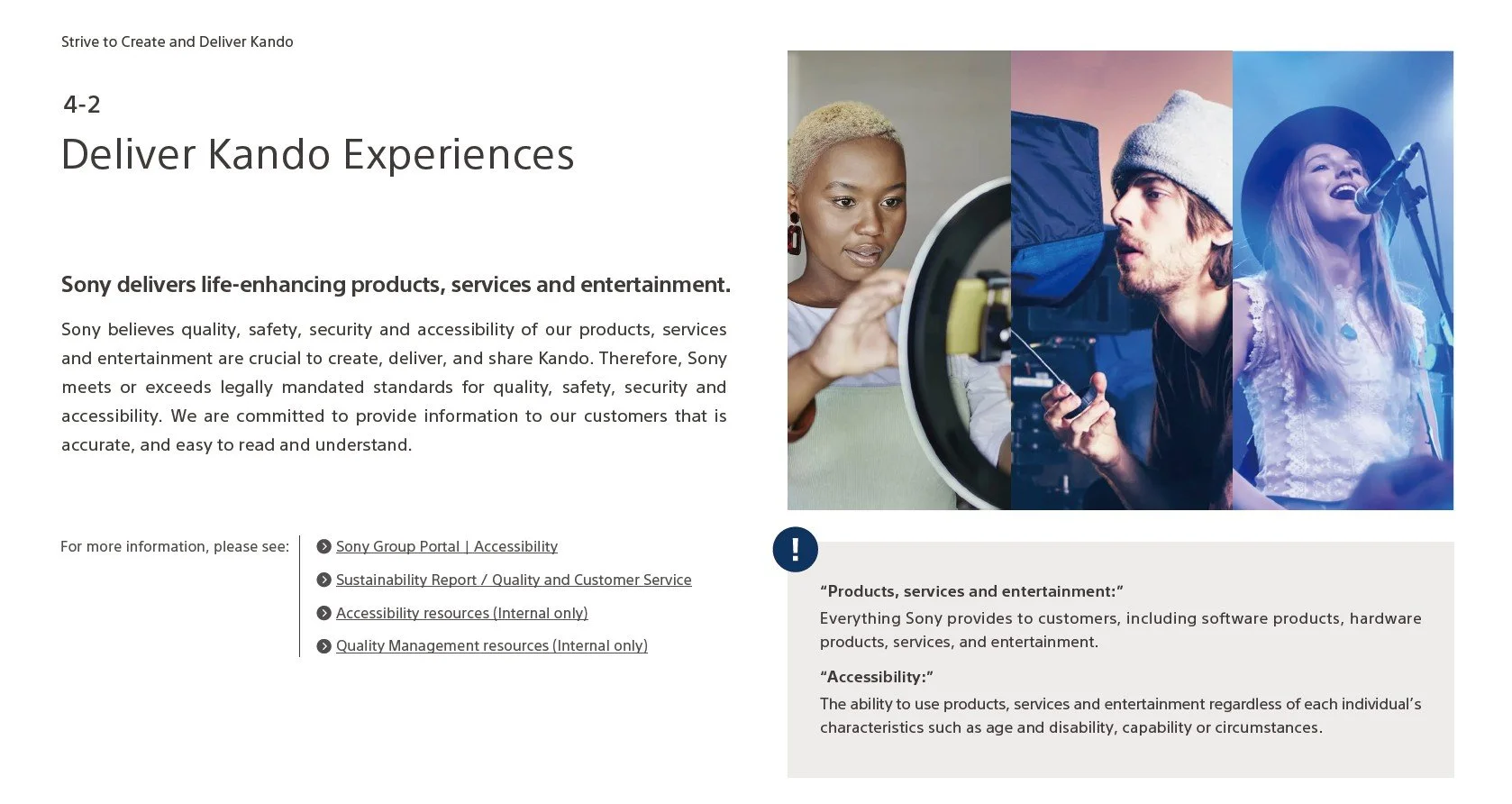
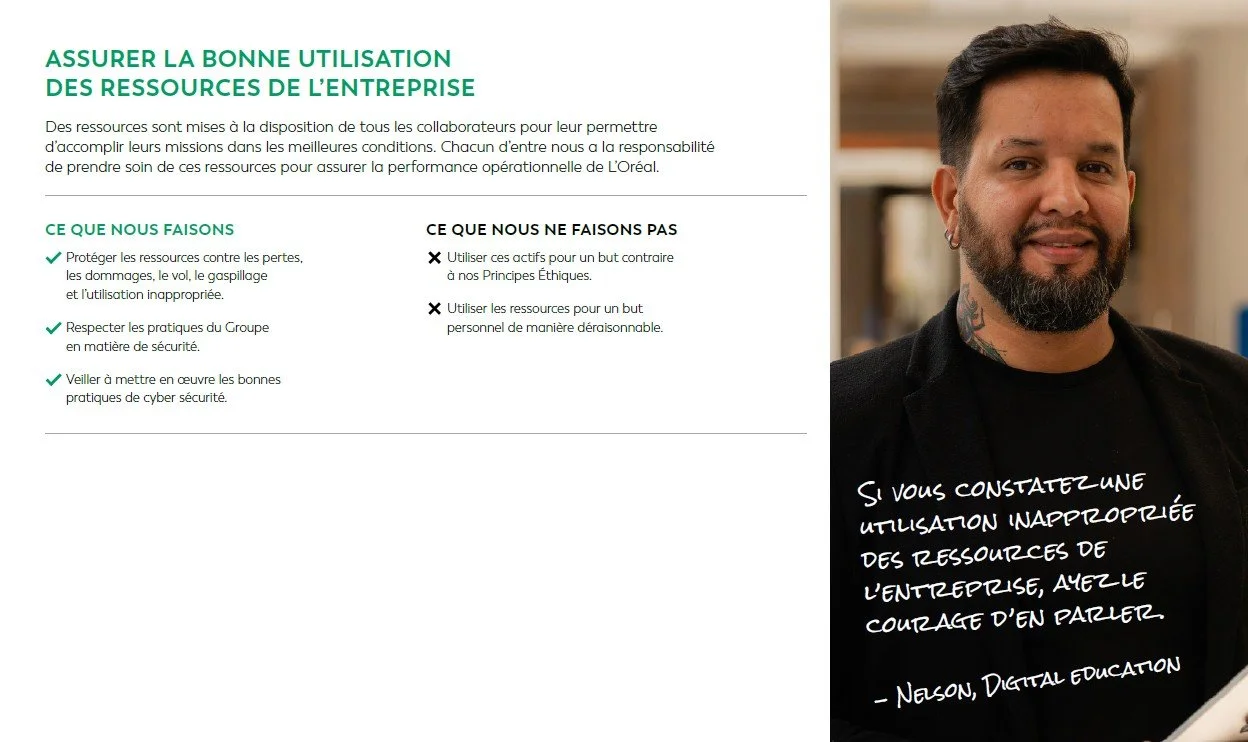
L’Oréal’s and Sony’s codes are consistent with the personalities and values of these companies. The rules are effective without being too generic. They are directly linked to the priorities of the organization and its employees.
2. Organize the content so that it is easy to browse
A code of ethics and conduct shouldn’t be read just once during the annual orientation, only to be forgotten until the following year! The code should also be useful throughout the year when ethical dilemmas arise.
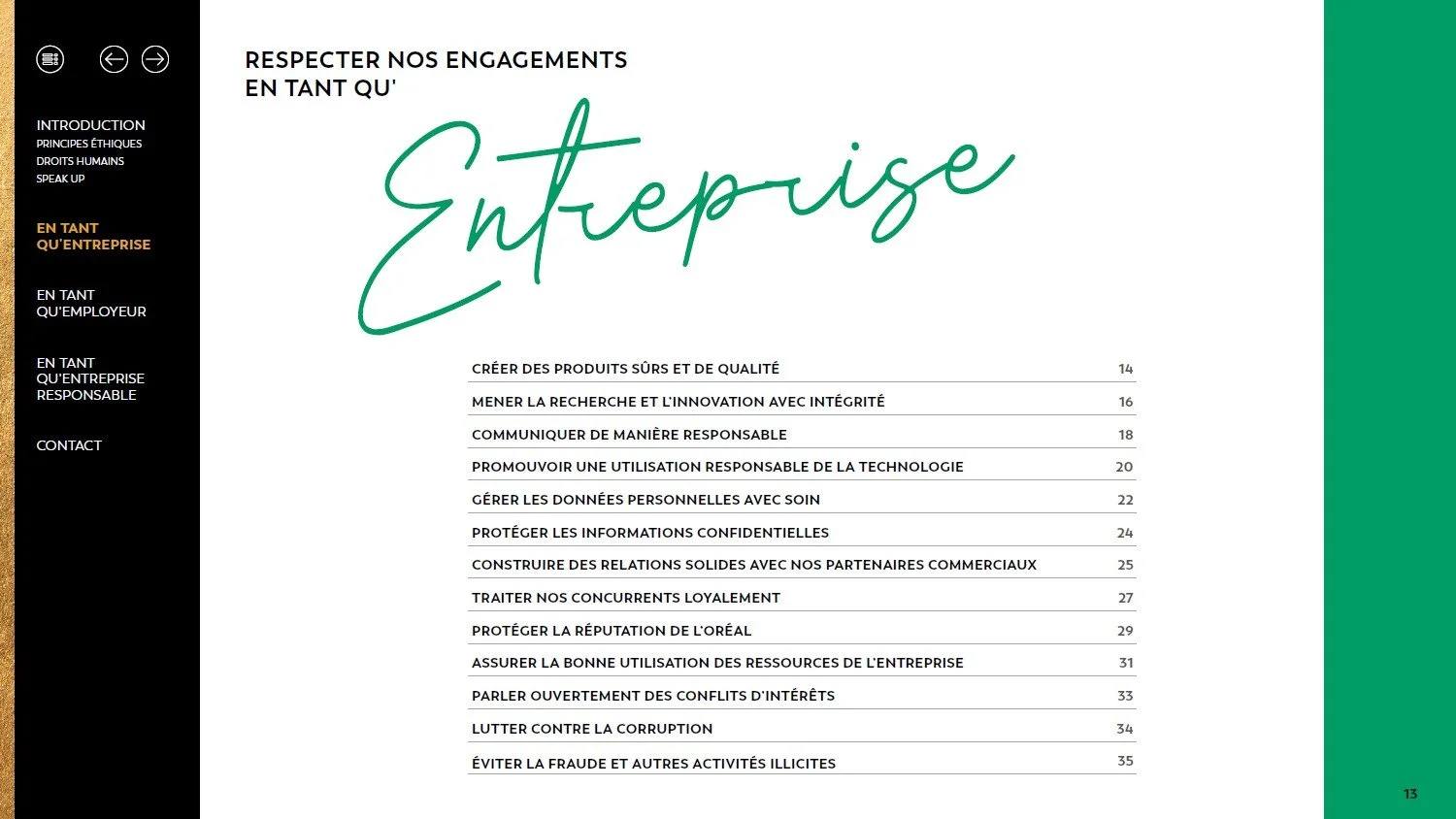
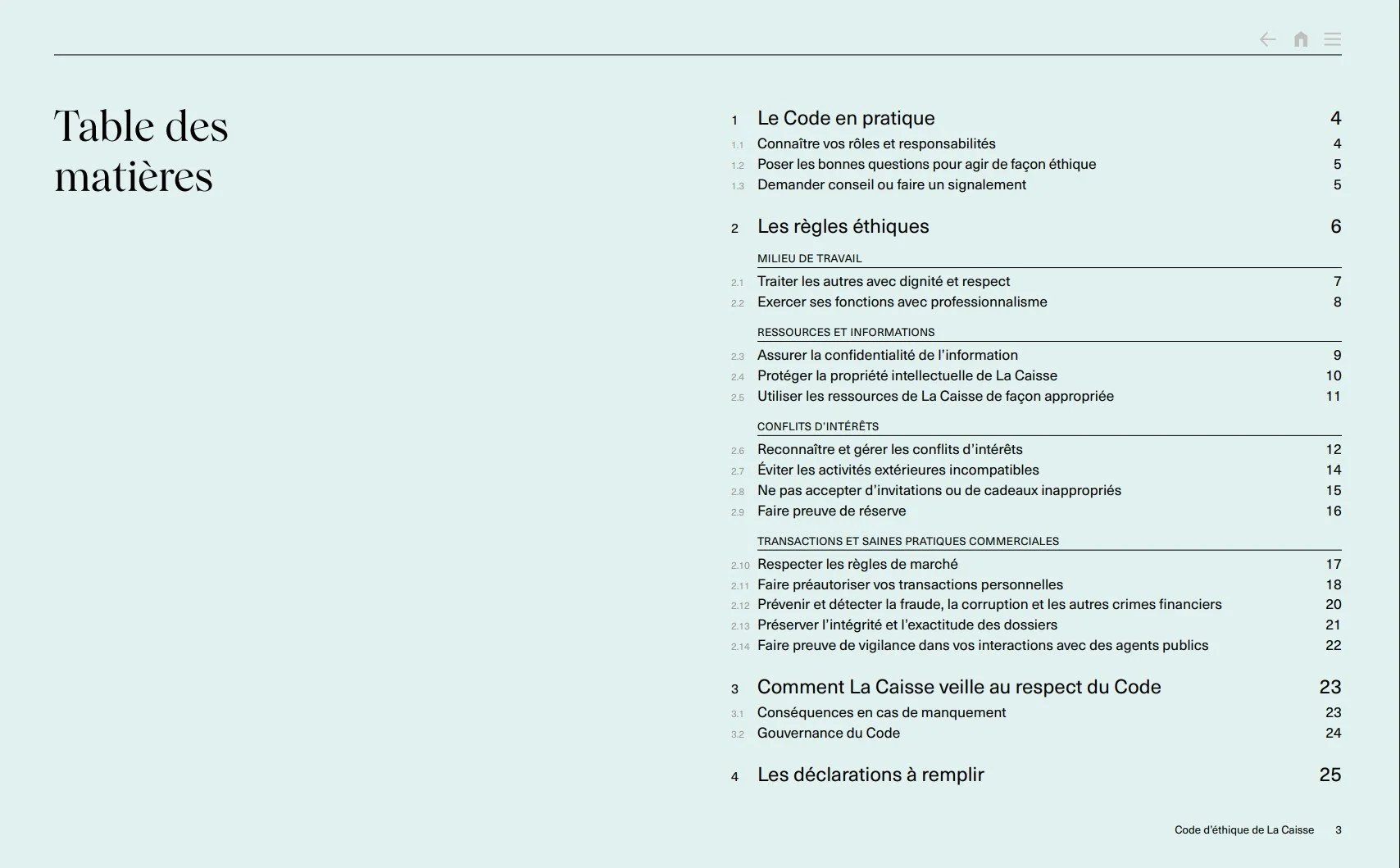
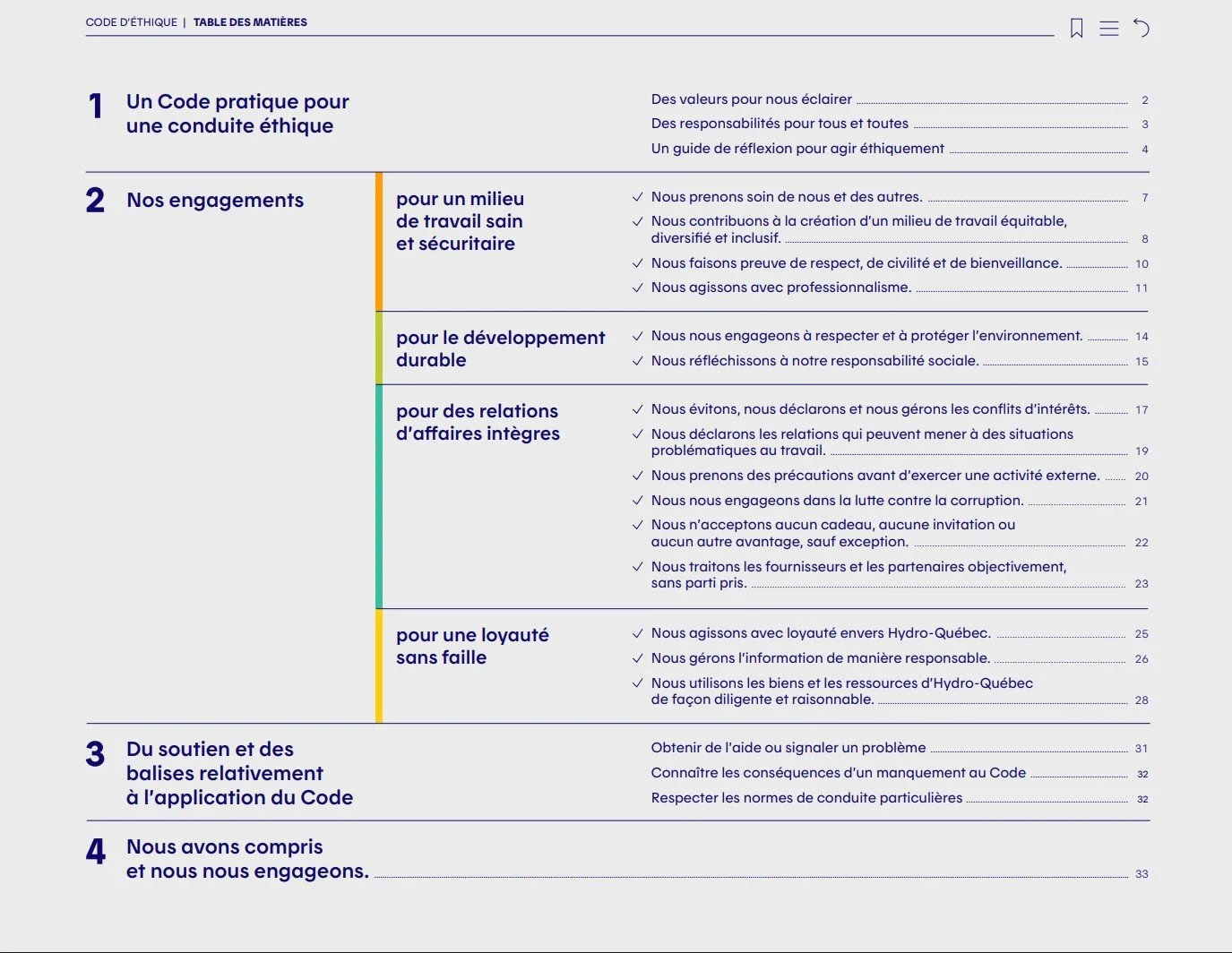
It starts with a table of contents that highlights an effective structure with descriptive headings. Why is this essential?
A well-structured document clearly shows what is important to the organization and serves as a guide during the annual review of the code.
The table of contents is also useful for those who encounter a problem during the school year. At a glance, they should be able to find the answer to their question.
Any examples? The tables of contents for the codes of ethics of the Caisse de dépôt et placement du Québec and Hydro-Québec summarize and categorize all the rules on a single page. That’s efficient!
3. Support accountability and sound decision-making
Compiling a list of prohibited behaviors can be reassuring for an organization, but this approach has several drawbacks.
Reading a list of rules like “don’t do a, b, c, etc.” isn’t very engaging. You also run the risk of falling into the trap of being overly exhaustive if you try to list everything that’s prohibited. (Which seems impossible to do and is really quite boring to read 😉)
More and more codes are focusing on prevention, for example by providing decision-making tools to help manage ethical dilemmas effectively. This approach makes it possible to:
Focus on fostering a sense of responsibility and the ability to recognize ethical issues.
Empower your teams to make ethical decisions on their own.
Encourage communication with the team responsible for managing ethical issues.
An example? Here is a visual and useful ethical decision-making framework, published in the Lassonde Code of Ethics.
4. Clearly communicate your expectations
The people covered by your code need to know how to act after reading it. That’s the basics, but this essential goal is sometimes easier said than done.
Here are a few tips on how to do that:
Explain specifically why and how the Code’s guidelines help fulfill your organization’s mission and values. The Code does not exist in isolation from your day-to-day activities. Ground it in your reality, and it will be more effective.
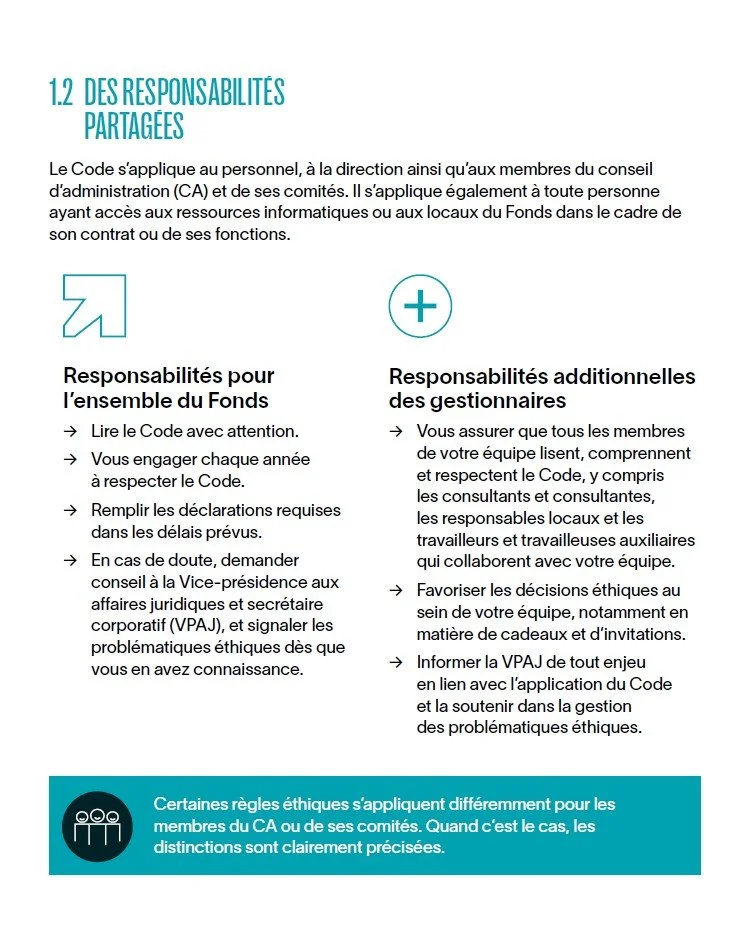
Clearly define roles and responsibilities (see the example of the Fonds de Solidarité FTQ below):
general policies, for all staff members, for example.
specific and additional ones, for managers or HR teams, for example.
Let people know who to contact if they have problems or questions. If your process for requesting help is complicated… maybe it’s time to simplify it, too!
Clearly state the consequences of noncompliance.
Establish clear and concise rules or ethical principles! As you draft your code, you may realize that some rules are vague or repetitive. Sometimes, the problem can be fixed with effective wording. But when the rule itself is ambiguous, clarify it!
When a rule is vague and difficult to express, you can’t expect your teams to know how to follow it.
One final tip to wrap things up: make choices to avoid the trap of being overly exhaustive. Remember that code is part of an ecosystem of documents. Certain details may be found in policies, checklists, training materials, guidelines, employment contracts, and so on. Make good use of them!
Contact En Clair to review your organization’s Code of Ethics
Our services include :
Write your code from scratch
support your in-house editorial team
facilitate ideation workshops on tone, level of detail, graphic style, level of simplification, etc.