
At En Clair, legal design and service design are at the heart of our work to simplify complex content and processes. Service design is unique in that it takes into account the user experience as a whole and all of their interactions, whether visible or not. So part of our work happens behind the scenes! By incorporating these principles into our daily work, we can optimize not only the visual aspect of a document but also the overall user experience by focusing on the features that best meet their needs.
What is the first image that comes to mind when you hear the word “design”? A piece of furniture, a logo, a website, a beautifully decorated room, or perhaps a modern building?
Most people tend to automatically associate design with aesthetics. This is understandable, since aesthetics are often a desired characteristic in design. However, it is not the only characteristic a design can have.
What exactly is service design? Here’s a look at the features that can transform your users’ experience.
The chair is beautiful, but it's also…
Let’s first take the design of a tangible object, such as a chair, as an example. A poorly designed chair can have negative repercussions on the health, safety, comfort, and productivity of its users. The product designer must therefore identify the most important characteristics—namely, those that will best meet the users’ needs, given the context of use.
For example, a user might want their chair to be very:
Comfortable, if he has to spend long hours sitting in it.
Stable, even if more fragile individuals, such as babies, need to sit on it.
Durable, even if the chair is left outdoors exposed to the sun, snow, and rain.
Portable, if the user wants it to be easy to take along on camping trips.
Product designers, therefore, have many factors to consider to ensure that users have a positive experience with their chairs. What about service designers?
A doctor's appointment is…
Let’s now consider the journey of a patient seeking a medical consultation. Here again, the designer must take into account the overall user experience when creating or improving this type of service. For a process like this, it may involve several steps, such as:
Scheduling an appointment (online, in person, or by phone)
The trip to the doctor's office
Check-in upon arrival
Waiting on site
The meeting itself
Following the advice given by the medical staff we met (prescriptions, exercises, etc.)
Follow-up, if necessary

Each step involves several touchpoints with tools, spaces, or people. The service designer must therefore identify the features that will best meet users’ needs at each of these touchpoints. For example, patients might want the on-site waiting step to include:
Guidelines
Claires, so you can wait as little as possible, easily figure out when your appointment is, and get the right directions to the correct waiting room.
Diverse and inclusive, to ensure accessibility for everyone (some patients will not be able to hear the audio prompts, while others will not be able to see the visual prompts).
A waiting area
Comfortable and entertaining, to make the wait more bearable.
Accessible to people with limited mobility.
Staff members
Attentive and empathetic, ready to help patients as needed.
Discreet, to protect the confidentiality of certain information.

The steps listed above and the examples of points of contact related to the waiting phase primarily concern the patient, but several other people are involved in the process and must be taken into account, such as:
Administrative staff, who are responsible for coordinating appointments, medical records, and follow-ups. They are also responsible for answering patients’ questions if the instructions are unclear or handling their complaints if the waiting area is not comfortable or entertaining.
Medical staff, who are responsible for preparing for appointments, updating their patients' records, and ensuring that they stay within the allotted time for each appointment.
Thus, part of the patient experience also takes place behind the scenes. This part of the process is therefore invisible to patients, but it is just as important for ensuring the quality and effectiveness of the overall service.
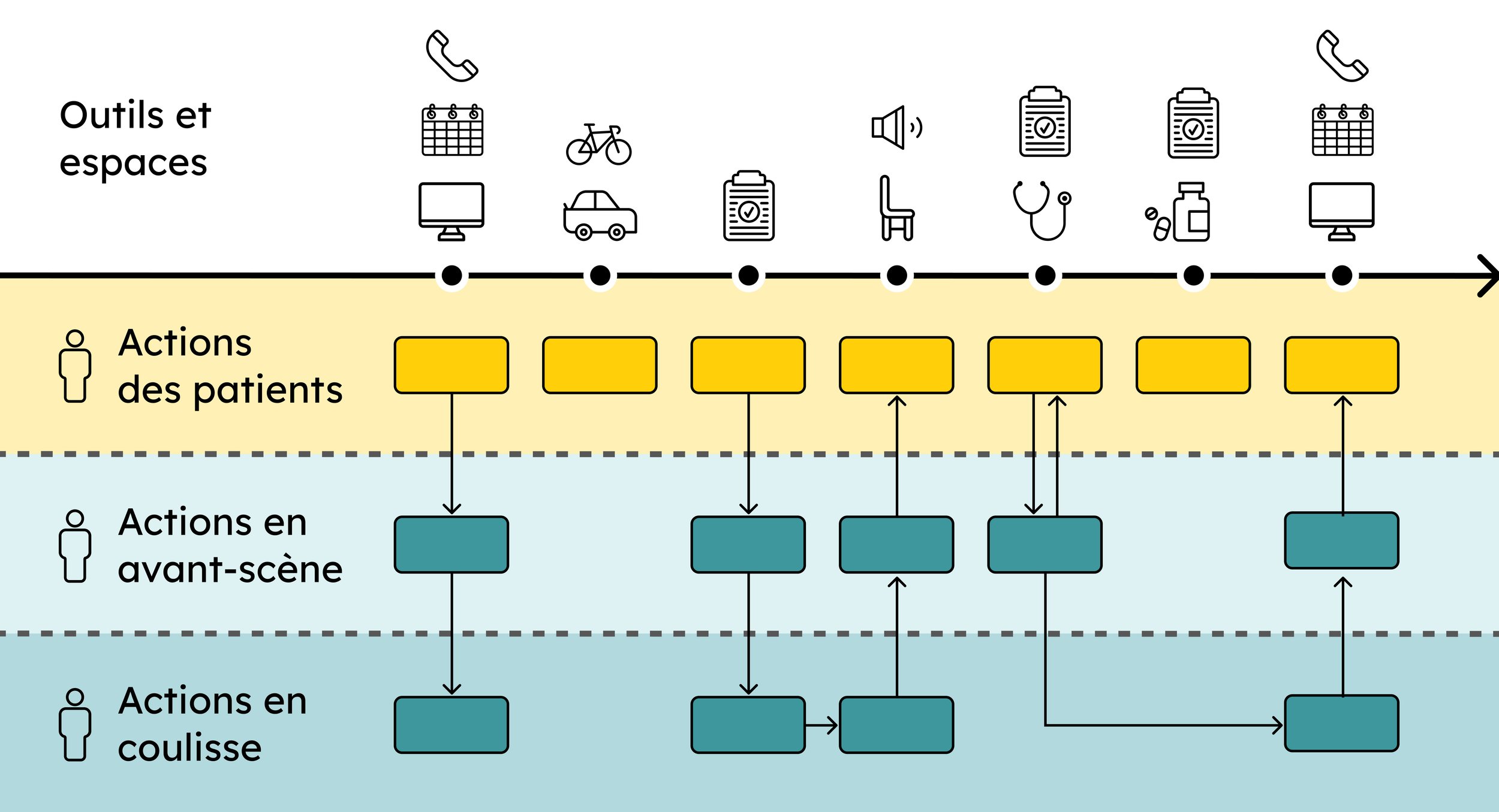
In summary
Product design focuses on creating a physical object, while service design focuses on the overall experience, taking into account the multiple interactions between internal users (medical staff), external users (patients), and various touchpoints. While a chair may be an important element of a user’s experience, it is just one touchpoint among many in the context of service design.
Service design therefore takes a holistic approach, incorporating aspects such as the customer and employee experience, operational processes, technology, and organizational culture.
This is a complex field of expertise that goes beyond aesthetics. This approach is therefore essential for creating consistent and satisfying user experiences.
At En Clair, we take into account the context, processes, and user journeys in which different types of content are embedded. For example, is the form that needs to be filled out during an initial medical consultation explained to the patient? Does the patient have access to resources if they have questions? Do they have enough time to read it? The form may be simple, but it can also be hard to find, often forgotten, or lost. That’s why we’ve also carried out several projects to optimize user journeys and processes to make the entire experience simpler.
→ Check out some of our projects!