Production En Clair
CDPQ Code of Ethics
How can we encourage employees and executives to commit to an organization’s ethical values and behaviors?
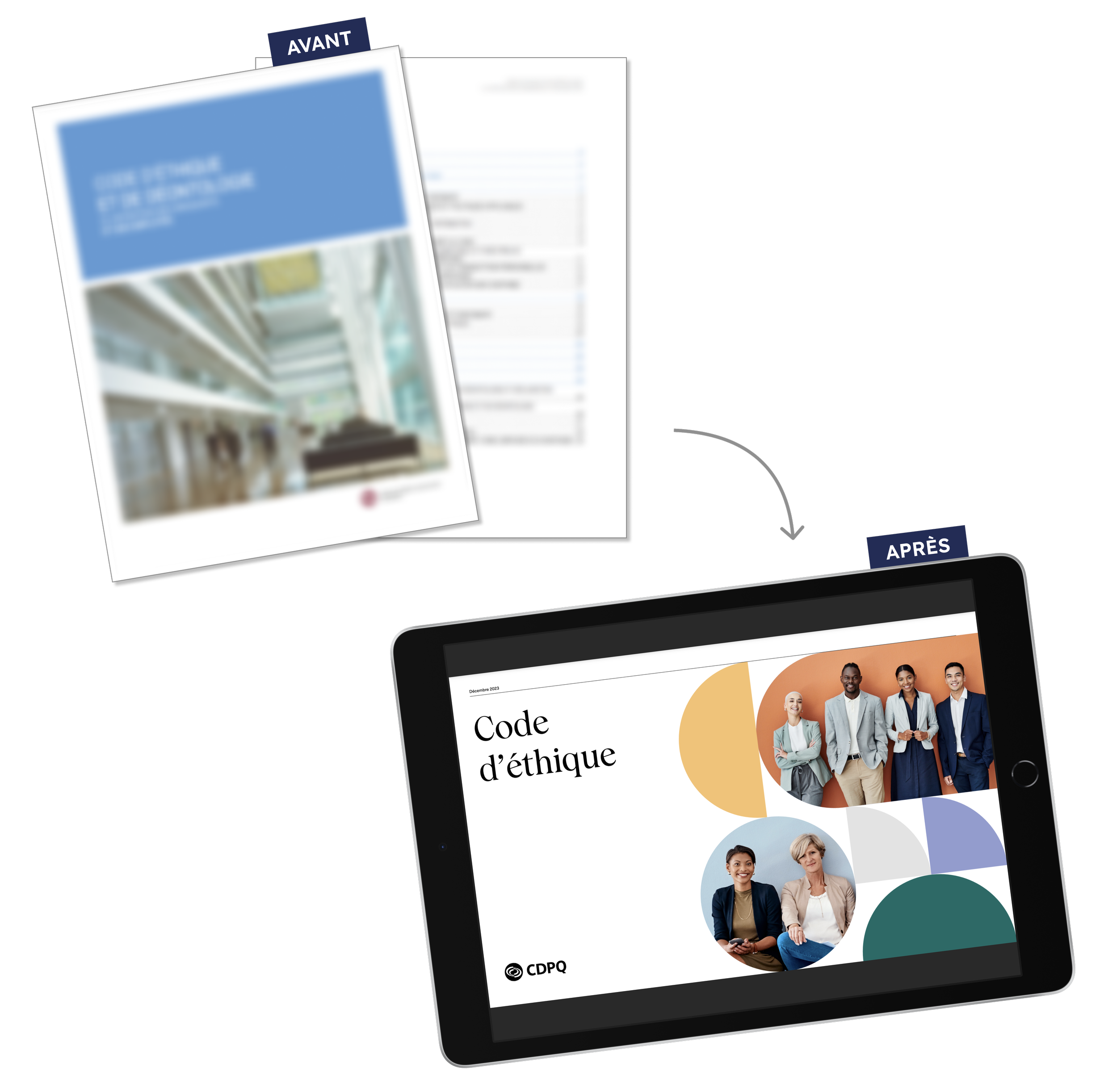
Our client: CDPQ, the Caisse de dépôt et placement du Québec
Project period: 2022–2023

Through a personalized approach and deep expertise in process simplification, En Clair has helped the CDPQ strengthen its leadership in ethics and compliance.
“Since the document was released, a great many people within the organization have expressed their satisfaction with it. Several have told us that it has helped them reflect on certain ethical issues. Ultimately, the exercise has given this document significant visibility within the organization, which is already a win.”
— Bruno Duguay, Vice President, Ethics and Compliance, CDPQ
It went beyond just ethics and compliance. Colleagues from other departments have contacted me several times to find out how we went about it and who we worked with. People appreciated the tone and clarity of the information, and I sense a willingness to follow a similar process for other documents.
— Audrey Chiasson, Esq., Senior Counsel, Ethics and Compliance, CDPQ
Our Mission
In 2022, the Caisse de dépôt et placement du Québec (CDPQ) undertook an ambitious overhaul of its Code of Ethics, with the goal of simplifying this strategic document while ensuring its relevance to its employees, partners, and all of its international offices.
With operations in multiple jurisdictions and across various sectors, the CDPQ needed to ensure that its Code reflected not only its core values (integrity, respect, professionalism) but also the diverse regulatory and cultural contexts of its offices.
Challenges
Organizational complexity: Adapt the Master Code to the operational and cultural realities of international offices while maintaining overall consistency.
Complex Language: Turning a technical legal document into a clear and accessible resource for everyone.
International Harmonization: Having a single document that meets the various ethical standards applicable in multiple countries.
Approach
En Clair has worked closely with the CDPQ to address these challenges by adopting a proven, collaborative approach:
Organizational Assessment: An in-depth analysis of the specific needs of the CDPQ and its international offices, taking into account local legal and cultural characteristics.
Collaborative workshops: Workshops with managers to gather their expectations, identify their challenges, and incorporate their input from the very beginning.
Modular structure: Design of a clear and adaptable core code that allows for customization for each subsidiary without compromising overall consistency.
Visual and textual simplification: Using clear language and visual aids (tables, infographics) to make the Code more intuitive and engaging.
Multicultural testing: Validation of the document with pilot groups from international offices to ensure its applicability.
Results
Clarity and accessibility: A Code of Ethics that speaks to everyone, from Montreal to Singapore, using simple language and concrete examples.
Enhanced Compliance: Clear rules that make it easier to understand.
Company-wide commitment: Employees and executives welcomed a Code that reflects CDPQ’s values while taking their operational realities into account.
Would you like to simplify your code of ethics, too?
It's that simple. All of our clients started by talking to us.
Schedule a free exploratory call for free now.
Overview of Our Approach
-
![]()
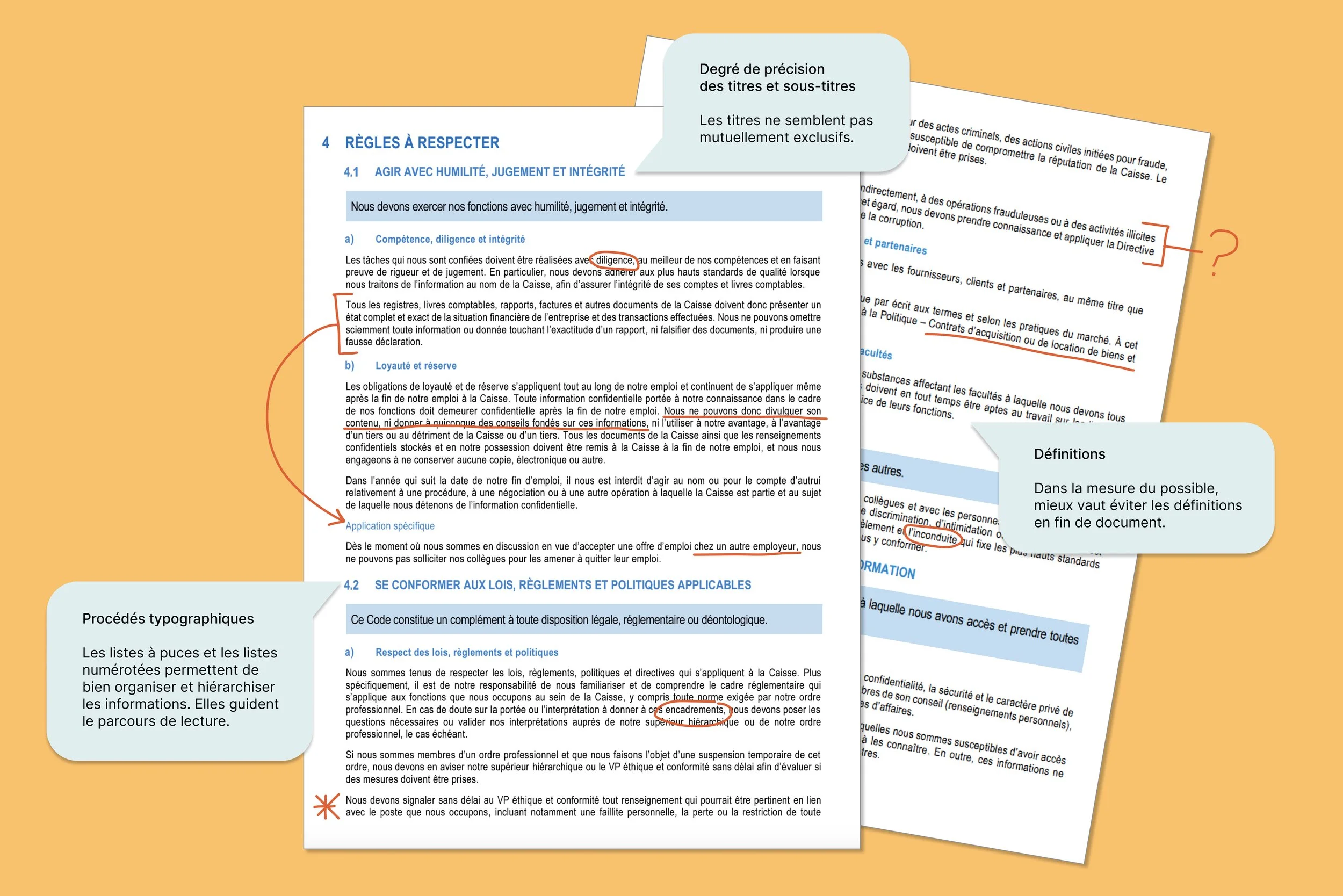
Step 1: Diagnose the old code
Analysis of the current code to identify its strengths and weaknesses in terms of structure, messaging, and design.
Benchmarking to identify standard and innovative practices in the industry.
Q&A workshop on the content of the code: ambiguities, inconsistencies, clarification of messages, etc.
-
![Persona Profiles]()
Step 2: Understanding the Needs of Employees and Administrators
Individual interviews with employees and administrators: The questions asked focused on the clarity of the former code, its relevance, its accessibility, and its effectiveness in addressing real ethical issues.
Types of questions: quantitative (point-scale questions) and qualitative (open-ended questions) to collect different types of data.
Thematic focus group interviews. Five focus group sessions were held on certain key ethical guidelines. Participants came from different sectors of the organization to draw on a variety of expertise and perspectives on the code, guidelines, and ethical values.
Several facilitation tools were used:
Survey – to gauge the general level of understanding of the code and rules
Open Discussion – for certain ethical issues that are more difficult to understand or are perceived as more complex
Scenario-Based Questions - to determine the various possible reactions or decisions in response to the same situation
-
![]()
Step 3: Brainstorm possible solutions through ideation and prototyping
Ideation workshop on how the Code could be worded and organized to better reflect the reality of the Caisse.
During this workshop, we presented the research findings to the CDPQ teams so they could use them to make their decision. This helped them better understand:
how employees read or reviewed the Code
their level of understanding and perceived understanding
their views on what worked well and what did not work in the previous Code
the respondent's experiences with ethical issues and suggestions for improvement.
This workshop made it possible to agree on a more effective set of ethical guidelines and a structure for those guidelines that align with the CDPQ’s values. The guidelines have shifted from a legal framework to “commitment-based” actions rooted in the Caisse’s business reality, while maintaining all legal obligations.


Results
An inviting table of contents, where it takes just a few seconds to find the information you need

Clearer and more binding ethical guidelines that focus on prevention

3 Practical Tools
-

Tool 1: Making Ethical Decisions
This four-step tool is designed for situations that require sound judgment and careful consideration. The goal of the CDPQ is to encourage readers to consult the Ethics and Compliance team whenever they have doubts about a situation.
-

Tool 2: Identifying Conflicts of Interest
We have designed a dynamic, survey-style questionnaire that users can use to assess their situation.
-

Tool 3: Assessing the Acceptability of a Gift
We have designed a dynamic, survey-style questionnaire that staff can use to determine whether or not it is appropriate to accept a gift.